Section 702 of FISA, the controversial surveillance law that allows the FBI and intelligence agencies to spy on Americans’ communications without a warrant, is up for renewal in Congress. The law has been repeatedly misused, including to monitor journalists and activists. Yet, the Trump administration and some Democratic lawmakers are pushing Congress to reauthorize Section 702 without significant changes.
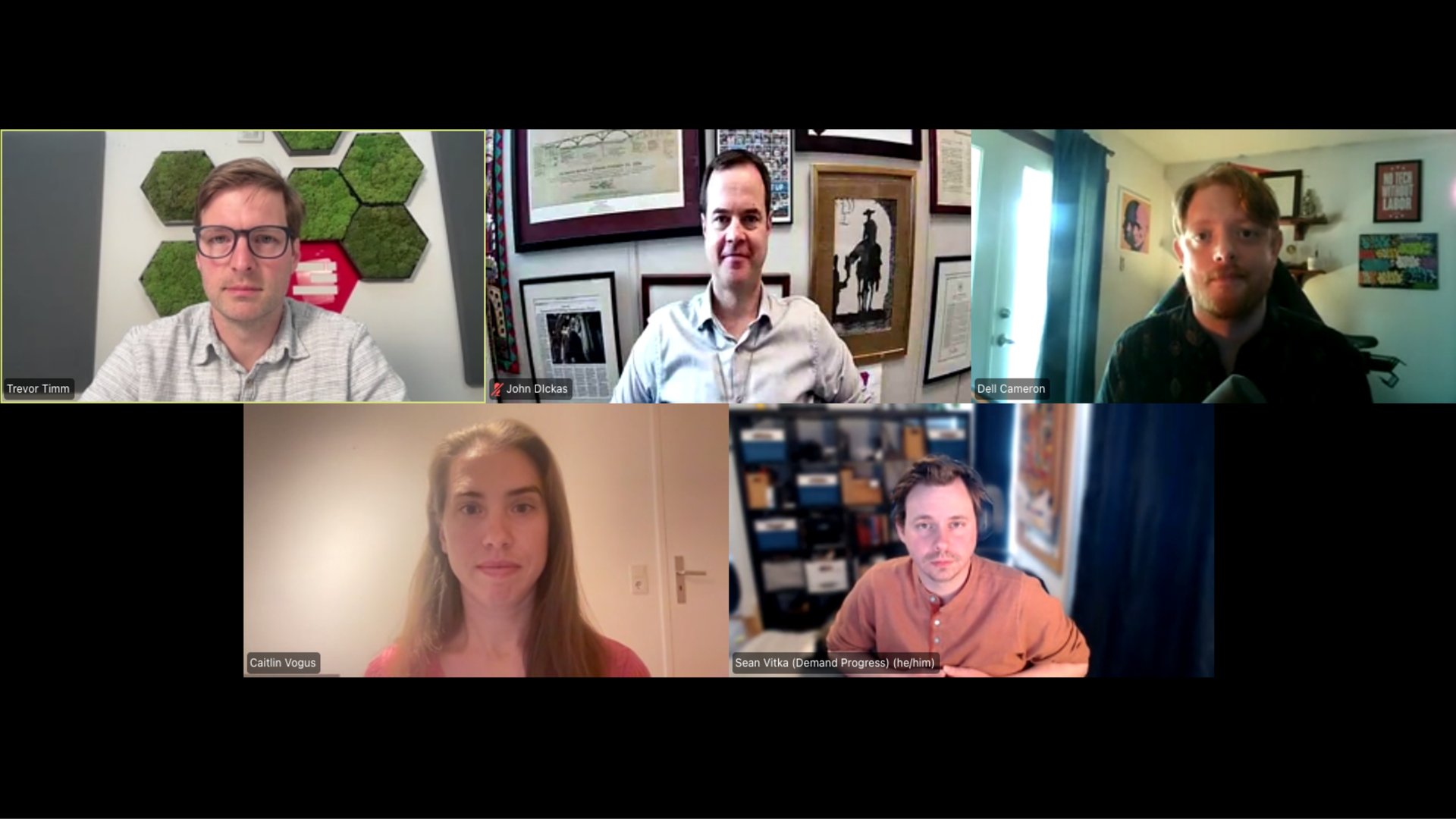
Freedom of the Press Foundation (FPF) recently spoke to four experts about Section 702: Dell Cameron, an investigative reporter for Wired who covers privacy and national security; John Dickas, Sen. Ron Wyden’s deputy chief of staff; Trevor Timm, executive director of FPF; and Sean Vitka, executive director of Demand Progress.
We talked about how surveillance affects freedom of the press and other First Amendment rights, and how Section 702 should be reformed to help limit the government’s power to spy on Americans.
Vitka emphasized how the government has overreached using Section 702 powers, highlighting examples of spying on Black Lives Matter protesters, elected officials, and judges. “When the executive branch gets to decide who they’re spying on and at what degree they can spy on them on its own, they inevitably do too much,” Vitka said. “They do things that chill our speech.”
Vitka said that Congress should not reauthorize the law without requiring a warrant before the government can search data collected under Section 702 for Americans’ communications. Congress must also close the “data broker loophole,” Vitka said, which currently allows the FBI and other agencies to buy data on Americans that they otherwise would require a warrant to access.
Timm, too, explained that Section 702 surveillance can be abused, including in ways that impact the press. “A journalist’s lifeblood is their ability to keep their sources safe and confidential from government intrusion or any other control, any other intrusion,” Timm explained. “If the government is able to vacuum up, for example, all of a journalist’s international contacts and communications, they would essentially be able to find out who all their international sources are, despite the fact that a journalist was completely complying with the law and just doing their job as they are allowed to under the First Amendment.”
Cameron highlighted his reporting about the government’s systemic noncompliance with the law when it comes to Section 702, noting that even the FISA court that oversees the program has cited the FBI for “persistent and widespread violations” in the past. Meanwhile, internal mechanisms intended to monitor the FBI and other agencies have been dismantled, Cameron said.
A lack of transparency and secret government interpretations of the law also make it difficult for journalists to report on it, and for lawmakers and the public to understand how Section 702 is being used.
Cameron noted his recent report for Wired on a letter from lawmakers, including Wyden, to Director of National Intelligence Tulsi Gabbard, asking her to clarify whether Americans using virtual private networks are vulnerable to spying under Section 702. It’s important to remember, Cameron said, that Section 702 is “being used in ways that we can’t really calculate, can’t understand, maybe never will.”
Dickas discussed Wyden’s efforts to protect Americans’ privacy and call attention to secret executive branch interpretations of Section 702 that have expanded the government’s surveillance power in the past. “Senator Wyden agrees that there is value to American’s national security in Section 702, but he’s also arguing pretty vociferously that it’s possible to make reforms to protect the privacy of Americans that do not diminish Section 702 national security value,” Dickas said.
A bill co-sponsored by Wyden and a bipartisan group of senators, the Government Surveillance Reform Act, would reauthorize Section 702 while also making urgently needed reforms to the law, Dickas explained.
Watch the full conversation here.
You can tell your lawmaker not to renew Section 702 without including privacy reforms for Americans using FPF’s action center.
You can tell Congress to close the data broker loophole and stop AI-powered mass surveillance here.