Dear Friend of Press Freedom,
I’m Lauren Harper, the first Daniel Ellsberg chair on government secrecy at Freedom of the Press Foundation (FPF), and welcome to The Classifieds. Read on to learn about this week’s top secrecy news.
Happy Sunshine Week! DHS tells FOIA officers to hide records or get fired
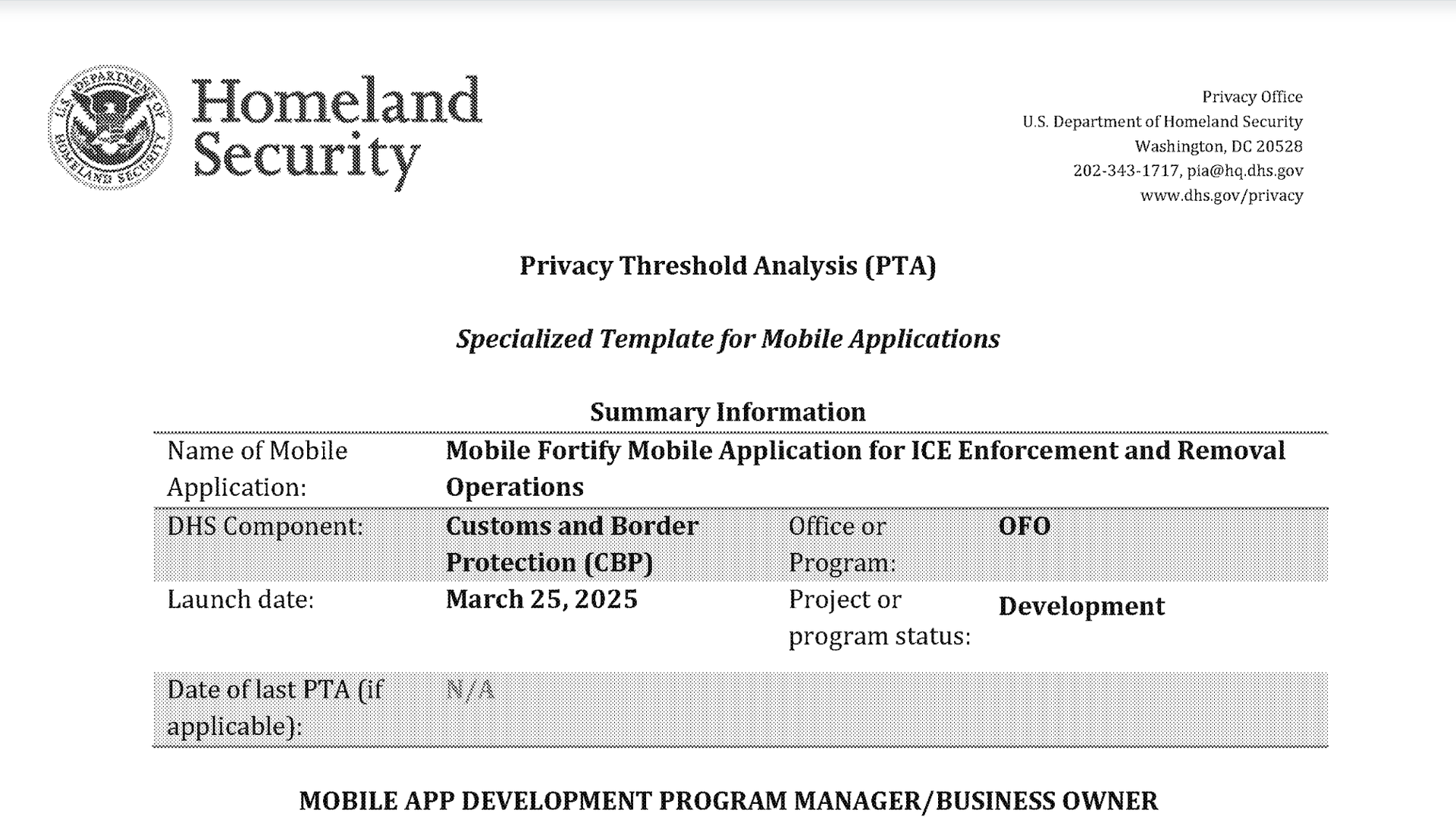
Department of Homeland Security leaders were so threatened by the agency’s lawful release of a document in response to a Freedom of Information Act request that they fired the Customs and Border Protection FOIA official who authorized its release.
DHS’s illegal and cowardly firing was in response to a FOIA release to 404 Media of a routine privacy analysis for the Mobile Fortify app, one of the agency’s many surveillance technologies. Mobile Fortify’s infamous claim to fame is that it allows immigration officials to capture facial images and fingerprints without consent, including those of U.S. citizens, and store that data for 15 years.
DHS is now trying to baselessly argue that routine privacy analyses are privileged and shouldn’t be shared with the public, even though DHS has previously released these reports and other agencies across the government regularly disclose them. The agency is also underhandedly adopting a policy that signed (and therefore completed) privacy analyses are “drafts,” allowing it to withhold those documents under the act’s oft-abused exemption 5, nicknamed the “withhold it because you want to” exemption.
Wired reporter Dell Cameron broke the story right before Sunshine Week, the annual celebration of the public’s right to know. It comes at the same time that many FOIA officials are furloughed during the ongoing partial DHS shutdown (the agency could easily fund its FOIA offices with its gargantuan budget, but it’s opting to shutter them instead).
The firing confirms that the agency, which is comfortable gobbling up your biometrics and location data and building what one agent called a “nice little database” to harass people exercising their First Amendment rights, draws the line at complying with FOIA requests. This will no doubt have a chilling effect across all of DHS’s FOIA offices (which include Immigration and Customs Enforcement, the Transportation Security Administration, and the Secret Service, in addition to CBP).
This is the second time the Trump administration appears to have retaliated against FOIA officials for refusing to keep the administration’s baseless secrets. Last summer, the Office of the Director of National Intelligence fired two FOIA officers who released a blockbuster document to FPF in response to one of our requests.
Is anyone in Congress going to finally, and forcefully, demand that agencies stop flouting our hallmark transparency law?
Rep. Tlaib introduces the Ellsberg Act
For too long, presidential administrations of both parties have weaponized the outdated Espionage Act to criminalize the whistleblowers and journalists who expose government wrongdoing.
Historically, the century-old law has been used to criminalize whistleblowers, like Daniel Ellsberg, the FPF co-founder who famously leaked the Pentagon Papers to prove four successive presidential administrations lied about the Vietnam War. Today, there are reports that President Donald Trump, who has been charged under the act himself, is eager to use the same outdated law against the press.
That’s why it’s great news that Rep. Rashida Tlaib has introduced the Daniel Ellsberg Press Freedom and Whistleblower Protection Act. This bill fixes the Espionage Act in three key ways:
- It protects the public by limiting the law to those who actually have a duty to protect government secrets, not the journalists or publishers who report on them.
- It targets overclassification by requiring information to be properly classified. This is a huge deal because anywhere between 75% and 90% of information is classified when it shouldn’t be.
- It forces the government to prove a defendant actually intended to harm the U.S. This shifts the focus from whistleblowers back to actual spies.
The Ellsberg Act finally brings the Espionage Act in line with essential First Amendment protections, ensuring it can no longer be used as a cudgel against the free press. This legislation rightly prioritizes the public’s right to know over self-serving secrecy claims.
Use our action center to tell your member of Congress to support the Ellsberg Act. You can also watch our discussion with Tlaib, Ellsberg’s son Robert Ellsberg, and Defending Rights & Dissent’s Chip Gibbons, who helped draft the bill, here.
What I'm reading
Democrats ask what happened to millions earmarked for Trump’s library
In settling their lawsuits brought by the Trump administration, ABC, Paramount, and other companies committed nearly $63 million to Trump’s presidential library foundation (which is not actually required to build a library). Then the foundation dissolved, prompting some in Congress to ask where the money went. It should prompt even more legislators to pass a bill that would require transparency for presidential library donations.
ProPublica wins lawsuit over access to court records in U.S. Navy cases
In a big transparency win, the Navy must now provide public access to criminal trial hearings and records. ProPublica’s deputy general counsel, Sarah Matthews, said of the ruling, “It’s the first time a civilian court has held that the First Amendment right of public access applies to military courts and records.”
Transparently yours,
Lauren Harper
Daniel Ellsberg Chair on Government Secrecy
Freedom of the Press Foundation