Dear Friend of Press Freedom,
I’m Lauren Harper, the first Daniel Ellsberg chair on government secrecy at Freedom of the Press Foundation (FPF), and welcome to The Classifieds. Read on to learn about this week’s top secrecy news.
FPF sues to see what agencies are doing with your data
As I wrote for The Intercept, the Trump administration is on its way to creating a centralized database containing intimate details about every resident of this country, fully searchable by artificial intelligence. This powerful tool would empower the government to conduct previously unimagined levels of surveillance and harassment against its own people.
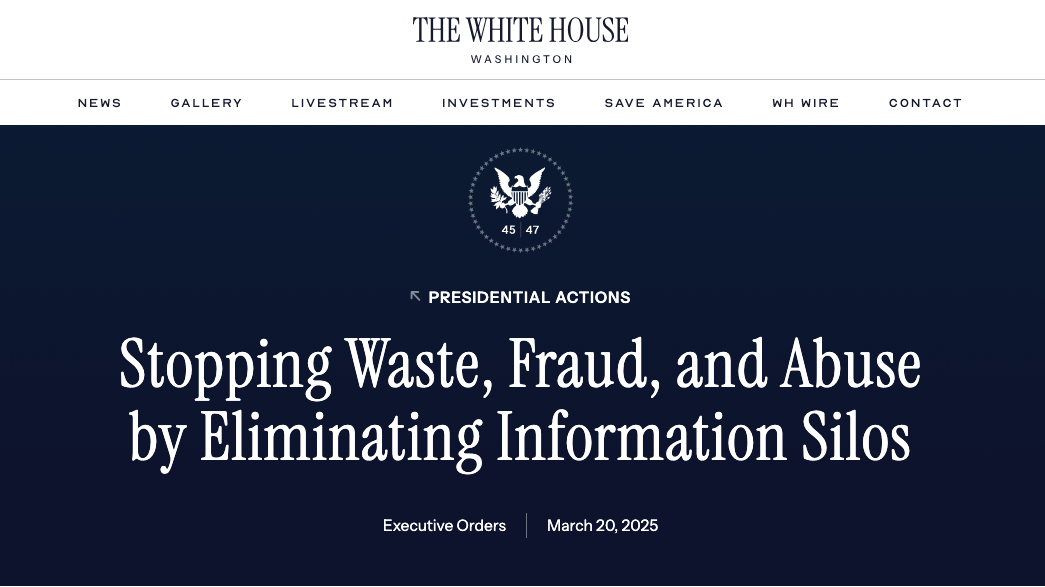
This nightmare privacy scenario began one year ago, when President Donald Trump issued an executive order that expanded data sharing across the federal government. The administration touted the order, “Stopping Waste, Fraud, and Abuse by Eliminating Information Silos,” as a way to target fraud within a supposedly bloated government.
The order was no such thing.
Instead, it took a machete to long-standing privacy protections that mandate agencies can only share our data when absolutely necessary, and installed a massive data-mining operation in their place.
And while the Trump administration recklessly seeks and compiles our data, it has simultaneously stopped sharing its data with the public. Vital information about the climate, immigration, federal spending, and the economy has been pulled from public view.
This is an untenable and antidemocratic information imbalance. To fight back, we need to fully understand just how badly our data and our privacy has been compromised. The agency reports submitted to the Office of Management and Budget in response to Trump’s executive order are essential for this investigation, which is why FPF is filing a Freedom of Information Act lawsuit against OMB for these records.
‘Most transparent administration in history’ makes FOIA even worse
Federal agencies can’t comply with the FOIA because of the Trump administration’s catastrophic staffing and budget cuts, according to The Washington Post’s FOIA coordinator, Nate Jones. In a Sunshine Week investigation, Jones and his team dug through 339 active FOIA lawsuits and found that more than a dozen agencies have declared in 26 cases that they can’t meet their production deadlines because of staff shortages.
The impacted agencies are: the Department of Education, the Department of Health and Human Services, the Department of Homeland Security, the African Development Foundation, the Bureau of Prisons, the Centers for Disease Control and Prevention, Citizenship and Immigration Services, the Drug Enforcement Administration, the FBI, the Food and Drug Administration, Immigration and Customs Enforcement, the National Institutes of Health, the Office of Personnel Management, the U.S. Agency for International Development, and the U.S. Institute of Peace.
Jones notes that agencies weren’t meeting their deadlines before the Trump administration, and FOIA lawsuits were clogging the courts prior to 2025. But the Post’s report leaves no room for doubt that Trump’s “most transparent administration in history” is actually making FOIA worse.
Are we in danger because of Iran strikes? DHS isn’t saying
At the time of writing, there have been at least two attacks in the United States potentially connected to the ongoing war with Iran. Yet none of DHS’s recent press releases have discussed this threat, opting instead to focus on immigration enforcement, and the agency has yet to update its expired National Terrorism Advisory. Nor has it published a supposedly annual Homeland Threat Assessment since Trump took office over a year ago.
This begs the obvious question: Is the agency stifling the release of intelligence that contradicts Trump’s claims that attacking Iran will make the U.S. safer? It wouldn’t be the first time; last year, Director of National Intelligence Tulsi Gabbard fired intelligence officials who authored an assessment on Venezuela that undermined Trump’s invocation of the Alien Enemies Act, and later fired FOIA officials who released the assessment to FPF.
What I'm reading
Wall Street bankers offered lucrative access to join the Pentagon
The Pentagon is getting help from the headhunting firm Heidrick & Struggles to build an investment team to handle a $200 billion pot of money. A powerpoint reveals the essence of the pitch: “If you ever want to raise your own fund, you will gain access to fund-raising channels that include royal families and foreign sovereign contacts.” FPF has filed a FOIA for the presentation.
The 2026 Foilies
The Electronic Frontier Foundation and MuckRock’s “The Foilies” highlight the biggest losers in government transparency. Our favorite “winner”? The multiple nominees for the “Flock you” awards. Read all the nominees here.
Transparently yours,
Lauren Harper
Daniel Ellsberg Chair on Government Secrecy
Freedom of the Press Foundation