By Joseph Cox
This article originally appeared in 404 Media. The article’s author, Joseph Cox, kindly allowed us to republish it. You can (and should) subscribe to 404 Media here.
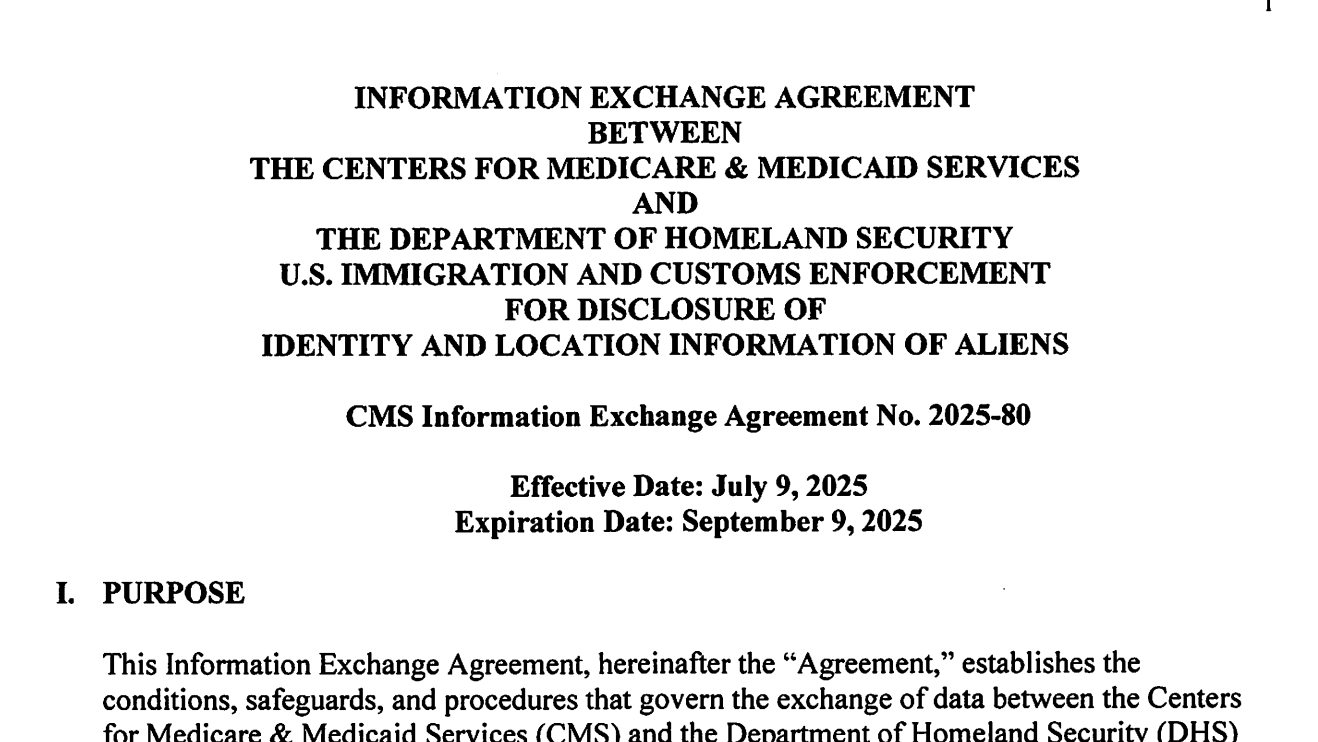
A data-sharing agreement between the Department of Homeland Security and the Centers for Medicare & Medicaid Services, which was designed for Immigration and Customs Enforcement to receive the personal data of nearly 80 million Medicaid patients, was recently published as part of a lawsuit, with the public now able to see the exact text of that unprecedented agreement.
Last year, Freedom of the Press Foundation (FPF) and 404 Media sued DHS for a copy of the agreement after the agency failed to turn it over in response to Freedom of Information Act requests. A U.S. attorney working on that case then flagged to our counsel that the document had been released in a separate lawsuit various states brought against the Department of Health and Human Services and DHS.
The full text of the agreement also shows the data promised to ICE included more granular data than previously reported, such as patients’ banking “routing number, account type, account number.”
“Access to this information will allow ICE to receive information concerning the identity and location of aliens in the United States, such as address, telephone number, banking information (routing number, account type, account number), email address, internet protocol (IP) addresses, or other information relevant to identifying and locating aliens in the United States,” the agreement reads.
The existence of the data-sharing agreement was reported at the time by The Associated Press and later by Wired. 404 Media has uploaded a copy here. At the end of December, a judge ruled that the Trump administration could resume sharing much of the data after it had been blocked from doing so, Politico reported. That means ICE can use Medicaid data in deportation cases starting Jan. 6, 2026, Politico added.
Under a section called “description of the data that may be disclosed,” the agreement says that data includes “Medicaid recipients: Name, address, assigned Medicaid identification number, social security number (SSN), date of birth, sex, phone number, locality, ethnicity and race.” The data allowed to be given to ICE under the new ruling is slightly narrower than that, and includes citizenship, immigration status, address, phone number, date of birth, and Medicaid ID, and is limited to people living unlawfully in the U.S., Politico reported.
In June, the AP reported Medicaid officials unsuccessfully fought to block the transfer of data related to millions of Medicaid enrollees from California, Illinois, Washington state, and Washington, D.C. Emails showed two top advisers to HHS Secretary Robert F. Kennedy Jr. ordered the data transfer, and the centers’ officials had 54 minutes to comply, the AP added. At the time, the exact purpose of the data-sharing was not known. Then the AP reported on the agreement itself that said the sharing was for ICE to locate aliens in the country.
CMS did not respond to 404 Media’s request for comment.
DHS Assistant Secretary Tricia McLaughlin told 404 Media in a statement, “President Trump consistently promised to protect Medicaid for eligible beneficiaries. To keep that promise after Joe Biden flooded our country with tens of millions of illegal aliens CMS and DHS are exploring an initiative to ensure that illegal aliens are not receiving Medicaid benefits that are meant for law-abiding Americans.”
Undocumented immigrants do not have access to federally funded health care coverage, including Medicaid, according to the nonpartisan, nonprofit organization American Immigration Council. Federal law mandates that hospitals provide emergency care regardless of the person’s immigration status, the organization says.
The agreement is part of a much wider practice of data-sharing across the second Trump administration and its mass deportation effort. The IRS has funneled data to ICE; in November, a court blocked that data-sharing. This month, The New York Times revealed the Transportation Security Administration was sharing multiple lists of people a week with ICE so immigration authorities could then detain them at airports.