Dear Friend of Press Freedom,
I’m Lauren Harper, the first Daniel Ellsberg chair on government secrecy at Freedom of the Press Foundation (FPF), and welcome to The Classifieds. Read on to learn about the week’s top secrecy news.
Immigration arrests and the FOIA black hole
The Department of Homeland Security paid the Miami-Dade Sheriff’s Office nearly $15 million for just seven immigration arrests. This is according to recent reporting from The Wall Street Journal, which tracked hundreds of millions of dollars in payments DHS made to local law enforcement as part of the agency’s controversial 287(g) program.
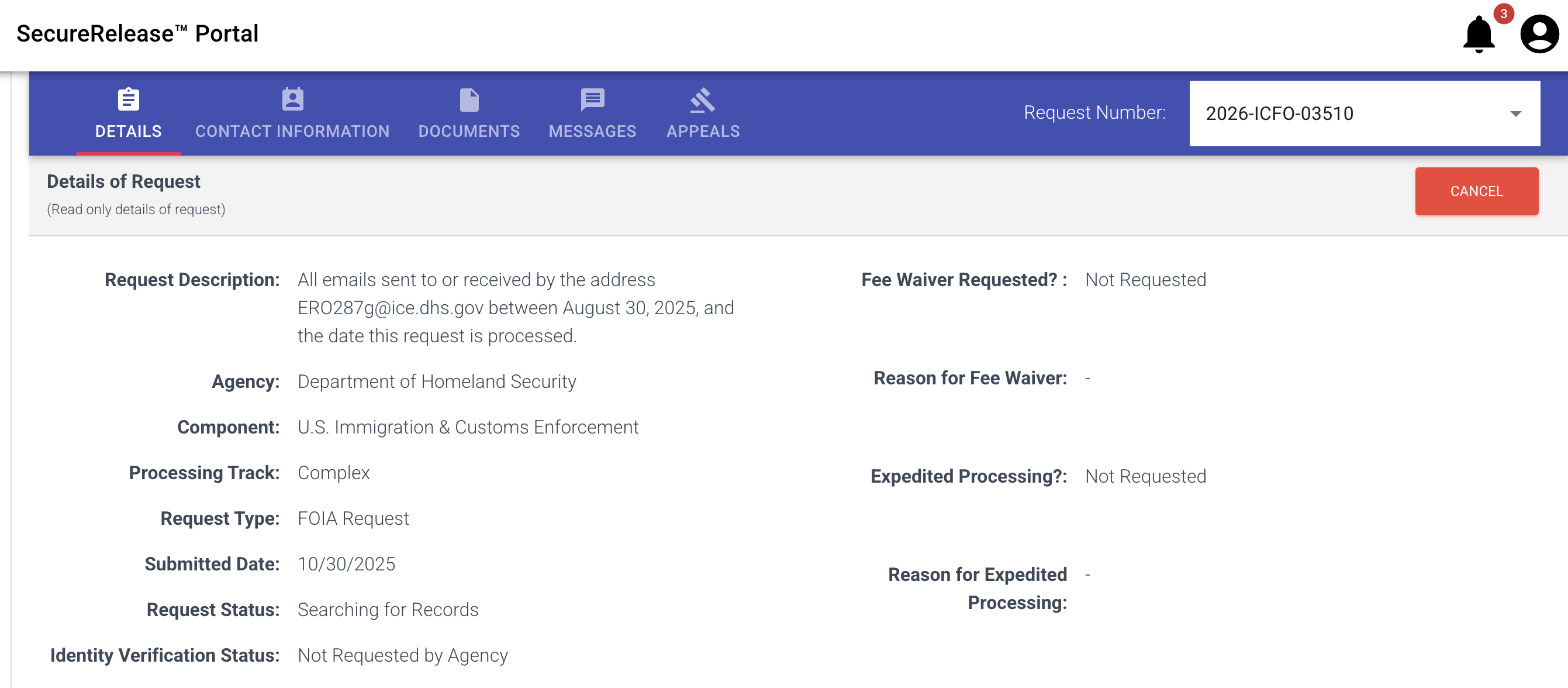
It’s clear DHS has more than enough money to throw at its policy priorities. Yet, when we filed a Freedom of Information Act request to learn more about the program, which allows DHS to pad local police budgets for participating in immigration enforcement, we were met with complete silence.
FPF submitted our FOIA request nearly a year ago, and we’re still waiting for a response. In fact, the Journal only learned how lucrative Miami-Dade’s participation in the program was through state records — not federal disclosures.
That’s because, despite being flush with taxpayer dollars, DHS refuses to fund basic transparency. Instead, the agency appears to be sabotaging its FOIA offices through staffing cuts and policies designed to not find records. Undermining the offices that respond to public requests for information is especially problematic because DHS press statements are often false. For example, DHS claims it’s not arresting U.S. citizens, but ProPublica found more than 500 cases of immigration agents doing exactly that.
Litigation shines a light on ICE’s actions
DHS increasingly ignores its FOIA requirements unless requesters sue — and even then, requesters are faced with more delays and agency stonewalling. Luckily, the watchdogs at American Oversight haven’t been deterred by ICE’s ongoing FOIA evasion. The group successfully took the agency to court and won the release of records showing both how dangerous ICE’s shock gloves are and how the agency cut training for the officers it deputizes under 287(g).
Litigation shouldn’t be the only way to force transparency, but as long as DHS flouts FOIA, lawsuits will remain essential.
FPF asks lawmakers to end SCOTUS secrecy
This week, FPF joined Fix the Court and nearly two dozen organizations in asking Congress to end one of the federal government’s most pernicious transparency failures: the enduring secrecy of Supreme Court justices’ working papers, which document the justices’ internal deliberations, draft opinions, and more. The secrecy around these papers denies the public important context for the court’s rulings and is exacerbated by the explosion of the shadow docket, which further keeps important legal rationales from the public.
The problem is that the justices’ working papers are treated as personal property, not public records, leaving their preservation or retention up to the individual justices. This is a stark departure from the executive branch policy that requires federal agencies and the Oval Office to preserve their records, and allows public access to them through FOIA.
The secrecy has always been unnecessary, and the fixes we suggest in our coalition letter are not brand new; they were proposed after Watergate. The simplest fix is to make the justices’ working papers public 12 to 15 years after a justice leaves the bench, an amount of time that mirrors the Presidential Records Act’s rule allowing presidential papers to remain closed for up to 12 years after a president leaves office.
Astronomical public records fees are alarmingly common
Last week, I wrote for The Intercept about how the city of Eugene, Oregon, is trying to charge nearly $2.5 million for a public records request about a single cop — an obvious intimidation tactic. This should have been an isolated incident, but almost immediately after that story broke, a town in Texas announced that it was charging $2.3 million for information about potential misuse of Flock’s fleet of AI cameras. Why? Because the city claimed searching for and reviewing these records would take 14 years.
What I’m reading
Decades after Watergate, Justice Department reviews whether Nixon got a raw deal
This makes a perverse kind of sense when you consider the administration’s broader push to dismantle post-Watergate accountability and transparency guardrails — most notably the Department of Justice’s attempt to torpedo the Presidential Records Act.
FBI has commissioned a classified and internal ‘Patel Report’ about times when it ‘fell short’
I’m all for the bureau being transparent about its past misdeeds, but devoting resources to responding to FOIA requests about its activities that have been lingering in its backlog for years would have been a much better use of its time, rather than throwing resources at the president’s favorite grievances.
Pam Bondi’s secret DOJ email address revealed
Former Attorney General Pam Bondi appears to have continued the long tradition of attorneys general using an alias for a second, unpublicized government email for official business. Her alias? [email protected]. This may explain why the DOJ could never find any of Bondi’s emails in response to our FOIA requests.
Transparently yours,
Lauren Harper
Daniel Ellsberg Chair on Government Secrecy
Freedom of the Press Foundation