Dear Friend of Press Freedom,
I’m Lauren Harper, the first Daniel Ellsberg chair on government secrecy at Freedom of the Press Foundation (FPF), and welcome to The Classifieds. Read on to learn about this week’s top secrecy news.
What terrible thing is the CIA doing now?
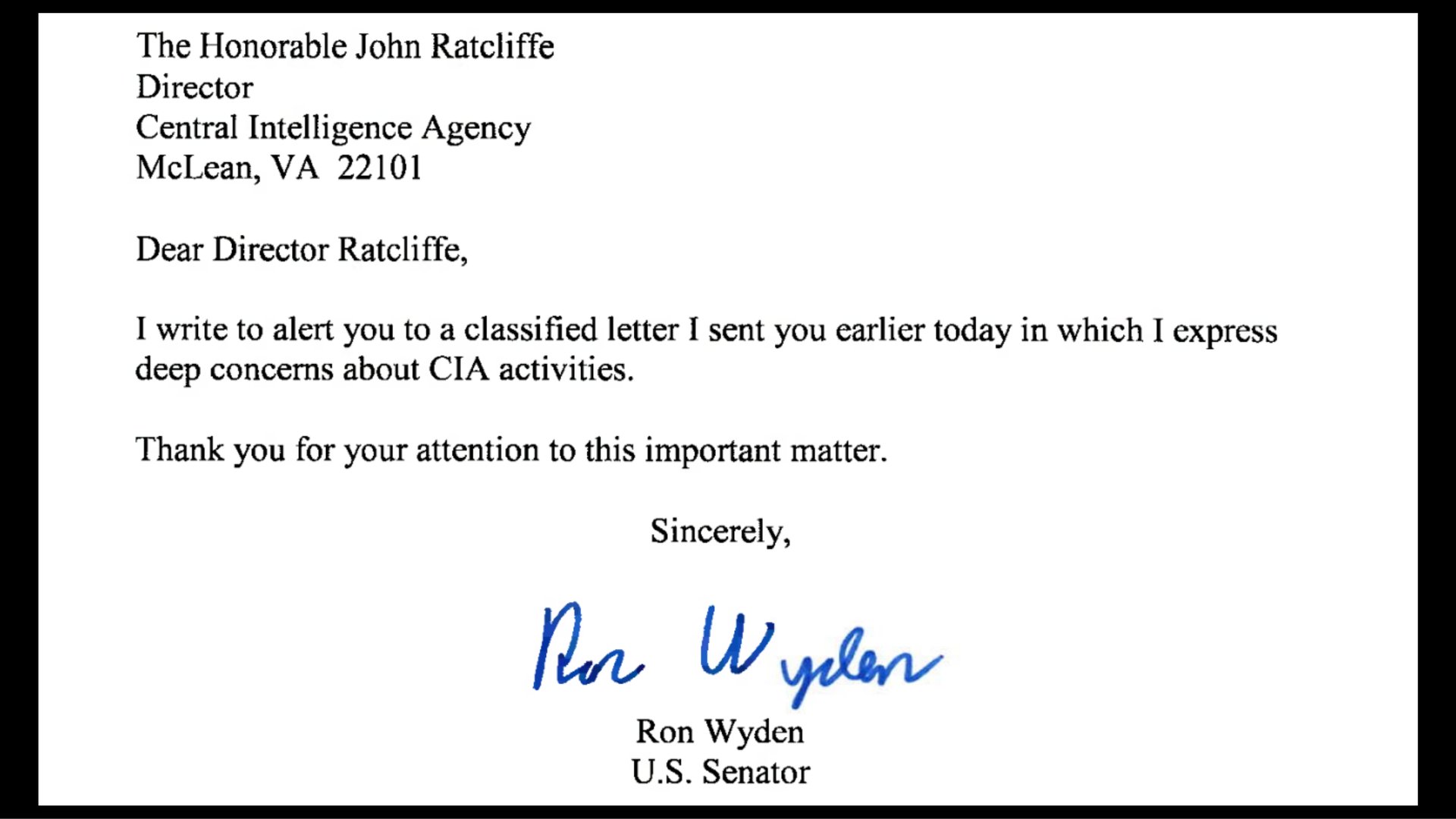
Sen. Ron Wyden recently drew attention to a classified letter he sent to CIA Director John Ratcliffe expressing his concerns about the agency’s activities. This might seem strange, but think of this as Wyden’s bat-signal to the public to notify us that something bad is happening.
We don’t know what Wyden’s concerns are, but we know they are a big deal. That’s because Wyden has a commendable track record of alerting Americans when spy agencies are abusing their power, most notably when he warned in 2011 that reauthorization of Section 215 of the Patriot Act was a mistake. Two years later, Edward Snowden’s revelations showed why — the government was abusing Section 215 to spy on Americans.
The opaque classification system will likely keep us in the dark about the exact nature of Wyden’s concerns for a long time, but we should still use the tools at our disposal to fight for transparency. To that end, I filed a Freedom of Information Act request with the CIA for Wyden’s classified letter, as well as all of the documents the CIA relied on in its response to him (if they bothered to send one at all).
FOIA is a long shot, but it’s worth trying. After all, a FOIA request filed by the National Security Archive ultimately won the release of the CIA’s “family jewels,” a collection of reports that cataloged decades of the agency’s worst abuses, from domestic surveillance to assassination plots of foreign leaders.
State Department purges X accounts
The State Department announced it will scrub its accounts on the social platform X, including those for U.S. embassies and ambassadors, of all posts predating the second Trump administration. The department argues this will decrease confusion, but the opposite is true. Effective statecraft requires an understanding of both the policies that worked in the past, and the ones that failed. The needless secrecy coincides with the CIA sunsetting its global factbook, and kneecaps diplomats at a time of heightened global tensions.
State maintains that it is archiving all removed posts in accordance with the Federal Records Act. However, the Internet Archive reports that X currently doesn’t allow archiving of its HTML pages, begging the question of how this might impact the State Department’s own internal archiving mechanisms.
Gabbard shuts down declassification task force
Director of National Intelligence Tulsi Gabbard reportedly shut down her nakedly partisan Director’s Initiatives Group late last year. The group, which touted declassification of documents in the public interest as one of its main goals, succeeded in releasing a grand total of 214 pages of documents. Underwhelming, to say the least. A better way to improve declassification would have been to empower the National Declassification Center with more resources and the authority to declassify other agency records, like those belonging to the CIA, FBI, and National Security Agency.
What I'm reading
Seven pages of a sealed Watergate file sat undiscovered. Until now.
In June 1975, a year after he resigned from the presidency, President Richard Nixon sat down for an 11-hour grand jury interview. The bulk of the grand jury records were declassified in 2011, but not everything. Seven pages, only recently published on the National Archives website and analyzed by reporter James Rosen, detail Nixon’s testimony about spying by the Joint Chiefs of Staff on the president’s National Security Council. Read the fascinating document here.
The disappearing art gallery in your post office
The U.S. Postal Service has an impressive art collection, including nearly 1,700 murals that were installed during President Franklin D. Roosevelt’s New Deal program. In the last 80 years, hundreds of these pieces have gone missing or been destroyed, even though the Postal Service is legally obligated to protect them. The Post used FOIA requests to understand what happened to the pieces, and to obtain photos of the missing art.
Epstein’s lawyers asked CIA for records that could show affiliation with agency
In 2011, lawyers for Jeffrey Epstein submitted FOIA requests to several spy agencies to see if they maintained records on their client. The FOIA requests (and denials) were released as part of the Justice Department’s compliance with the Epstein Files Transparency Act, but the redactions further call into question the quality of the Epstein files release. In one absurd example, the DOJ redacted the name of the CIA FOIA officer who responded to a request, but not the officer’s signature. Her name is Susan Viscuso, and hundreds of other FOIA requesters have letters with her name clearly written on them.
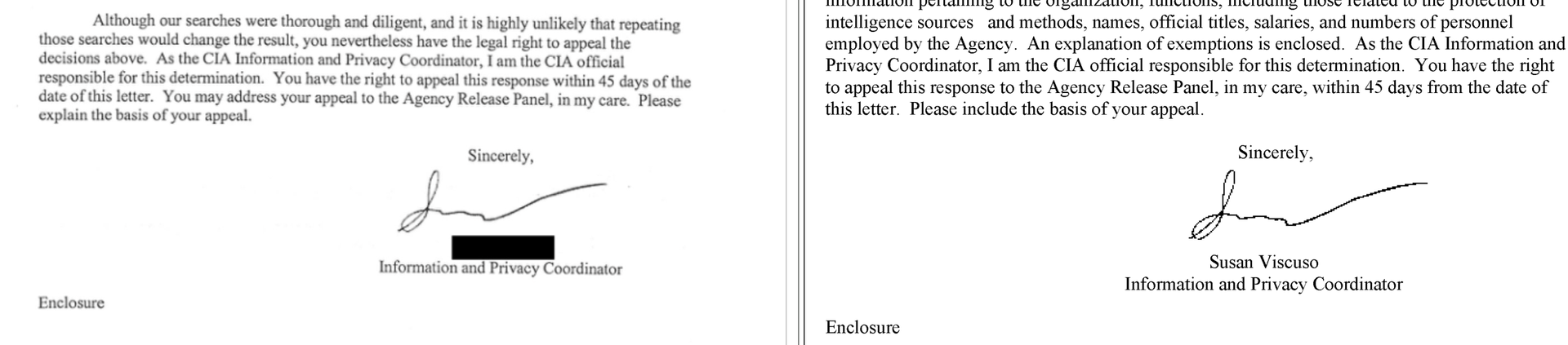
Epstein release on the left, normal CIA FOIA response on the right.
Transparently yours,
Lauren Harper
Daniel Ellsberg Chair on Government Secrecy
Freedom of the Press Foundation