Dear Friend of Press Freedom,
I’m Lauren Harper, the first Daniel Ellsberg chair on government secrecy at Freedom of the Press Foundation (FPF), and welcome to The Classifieds. Read on to learn about this week’s top secrecy news.
Afghanistan inspector general website missing
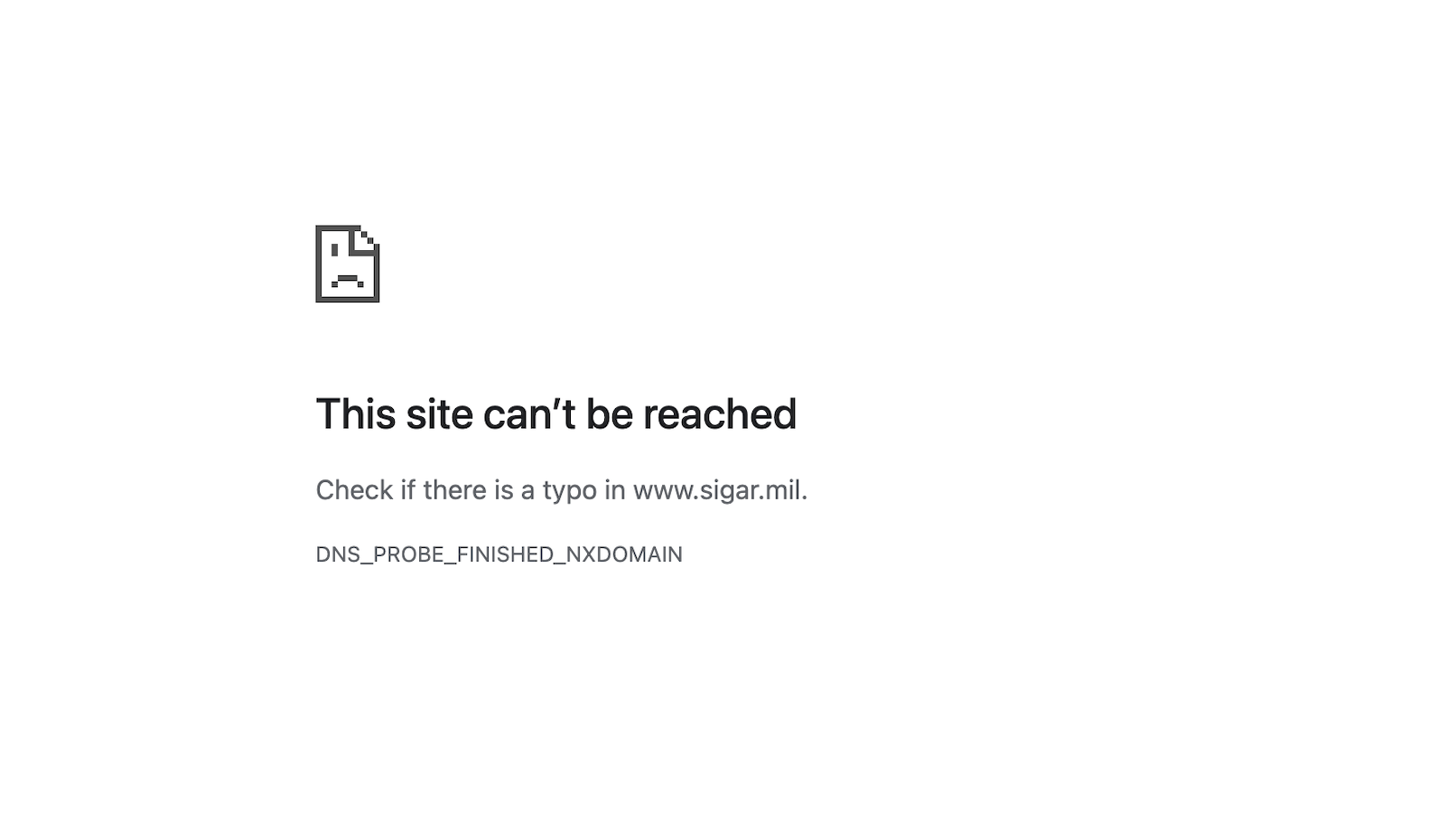
The Special Inspector General for Afghanistan Reconstruction ceased to exist on January 31, and its website is no longer accessible.
An archived version should be available on the government’s “CyberCemetery,” which is hosted by the University of North Texas, but it is nowhere to be found. It’s not clear why the site isn’t available yet, or when it will be published. (The CyberCemetery hosts the archived website for SIGAR’s sister agency, the Special Inspector General for Iraq Reconstruction.)
This means the public can’t access any of SIGAR’s reports, audits, or oral histories, which were unequivocal in their fight for accountability over America’s decades-long, exorbitantly expensive war in Afghanistan.
We’ll continue to monitor the situation, and report back if and when SIGAR’s archived website becomes available.
Congress needs to get serious about body cameras
Government lawyers (the same kind of lawyers who told us the Öztürk memos couldn’t be released — more on this below) recently promised that the Department of Homeland Security will preserve body camera footage of the slaying of Minneapolis, Minnesota, resident Alex Pretti. But it’s not yet clear how many agents were wearing cameras at the time they killed Pretti, or if DHS will properly preserve any existing footage.
Part of the problem dates to last year, when President Donald Trump rescinded a Biden-era executive order expanding federal law enforcement’s use of body cameras. Customs and Border Protection said it would stop using body cameras in the field shortly afterward, and the Drug Enforcement Agency ended its body camera program altogether.
And while Immigration and Customs Enforcement launched a body camera pilot program in 2024 that has not been rescinded, it only distributed cameras to agents in five cities: Baltimore, Philadelphia, Washington, Detroit, and Buffalo, New York. As a result, ICE told FPF in response to one of our Freedom of Information Act requests that it had no body camera footage from its Chicago operations.
Congressional appropriators are trying to address the obvious transparency gap by allocating $20 million for DHS’s body camera program. But nothing in the proposal requires agents to wear them. There’s also no funding for any of DHS’s FOIA offices, which the public usually turns to for body camera footage and where wait times for records can be years long.
If Congress is serious about improving DHS transparency, it needs to mandate that all immigration agents wear the cameras in the field, and that agency FOIA offices have direct access to the footage and enough resources to respond to the hundreds of thousands of requests the agency receives each year.
State Department’s secrecy claims are bogus
Last year, FPF filed a lawsuit against the State Department over its refusal to disclose information about the arrest of Tufts graduate student Rümeysa Öztürk for engaging in speech the administration didn’t like. Our suit sought two memos: One that reported the administration “had not produced any evidence” showing that Öztürk had engaged in antisemitic activities or publicly supported a terrorist organization, and another saying the revocation of her visa had been approved anyway.
The State Department recently told us that it had conducted a line-by-line review of both memos and determined it couldn’t release a single line of either.
Yet two days later, in a separate case challenging the deportation of noncitizens for ideological reasons, a judge unsealed one of those two documents, largely unredacted (see page 16).
This underscores the arbitrary nature of most secrecy decisions, and exposes the State Department’s secrecy claims as nothing more than unsubstantiated BS.
What I'm reading
Army general tapped to lead NSA said he doesn’t know much about the biggest NSA controversy
Lt. Gen. Joshua Rudd, the man nominated to lead the National Security Agency, recently testified that he was uninformed about the agency’s warrantless “backdoor” searches of Americans’ communications. This makes Rudd the latest in a very long line of government officials to make dubious claims (if not outright lies) about the NSA’s spying powers.
Statement on US Government Quitting Open Gov’t Partnership
The Trump administration has formally withdrawn from the Open Government Partnership, an international group the U.S. co-founded with the goal of making all governments more transparent.
Transparently yours,
Lauren Harper
Daniel Ellsberg Chair on Government Secrecy
Freedom of the Press Foundation