Dear Friend of Press Freedom,
I’m Lauren Harper, the first Daniel Ellsberg chair on government secrecy at Freedom of the Press Foundation (FPF), and welcome to The Classifieds. Read on to learn about this week’s top secrecy news.
What we FOIA’d from Trump’s first term
Presidential records from President Donald Trump’s first term are now subject to release under the Freedom of Information Act, and FPF has already filed 15 requests targeting critical transparency gaps.
Here’s the information we asked for:
- All of Trump’s direct messages from X, when the platform was known as Twitter, including any messages that might have been deleted.
- Copies of the White House visitor logs, which Trump refused to disclose in contrast to standard practice, as well as presidential daily diaries and call logs.
- A copy of the Senate’s 2014 report on the CIA’s torture program, which the Trump administration helped keep secret in 2017.
- White House communications concerning records retention policies and compliance with the Federal Records Act.
- Records about the storage and handling of classified material (including practices at Trump properties).
- National Security Council records about the lethal strike on Iranian Gen. Qassem Soleimani in January 2020.
- Records concerning election integrity, voter fraud, the certification of the Electoral College, and the events of Jan. 6, 2021.
- Documents about the violent clearing of protesters from Lafayette Square in Washington, D.C., on June 1, 2020.
- Communications documenting Trump’s reaction to the 2019 and 2021 impeachment proceedings.
- Memorandums of conversation with foreign leaders, including Vladimir Putin and Kim Jong Un, as well as written correspondence, such as Trump’s “love letters” with the North Korean leader.
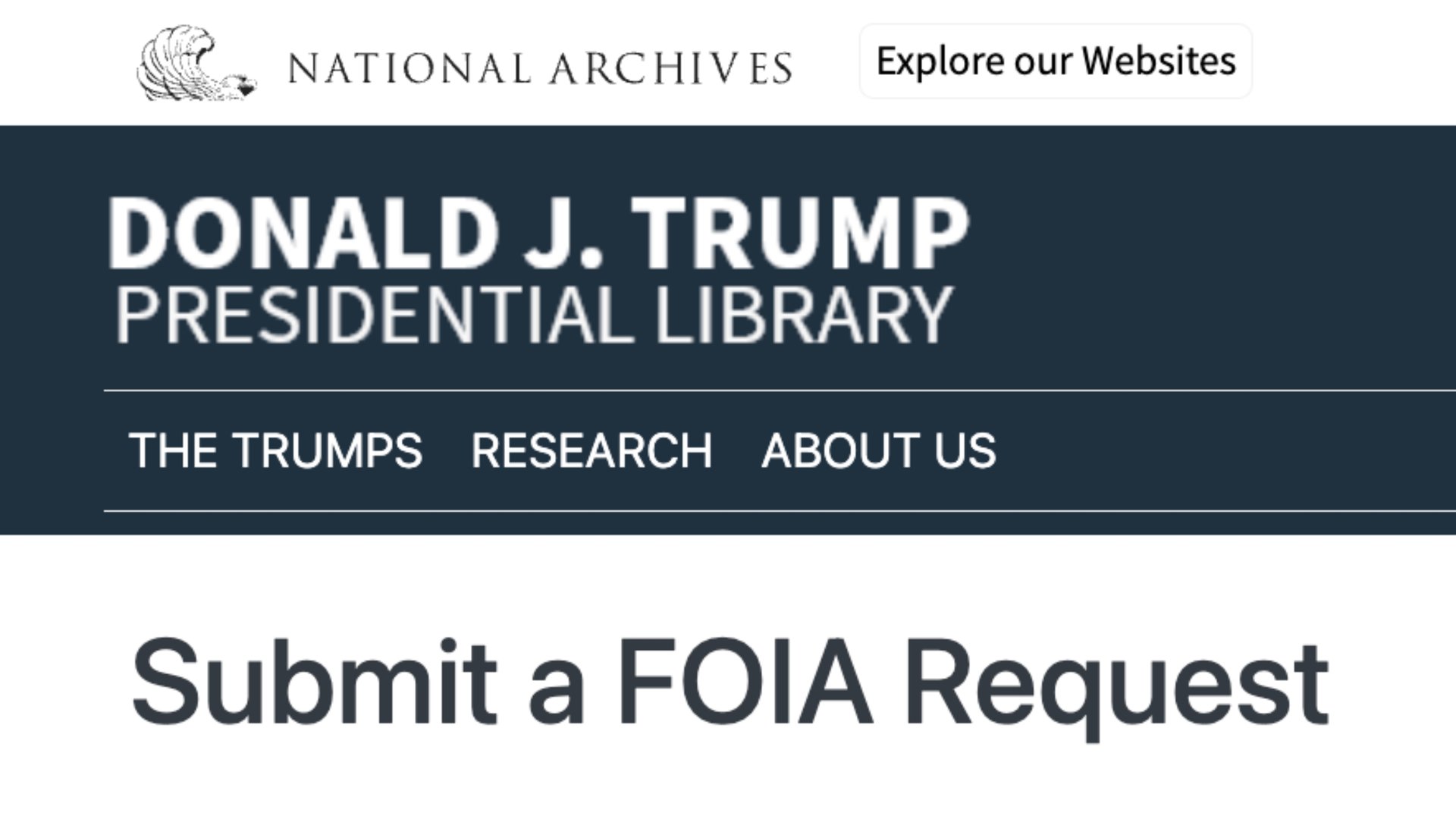
If you want to file your own FOIAs, use this form on the Donald J. Trump Presidential Library website. (Note that this is an official government website run by the National Archives and Records Administration, not affiliated with the museum/hotel/casino that Trump is building in Miami under the guise of being a library.)
While these records are now subject to FOIA, expect a long wait. If the backlog at the George W. Bush Library is any indication, it could take 12 years for one request to be answered.
To make matters worse, none of the at least half a billion dollars donated by media conglomerates and Arab monarchies to the Trump presidential library foundation will go toward declassification of Trump records. This is because the library foundation is a private organization, while NARA is in charge of reviewing and releasing presidential records. Problematically, NARA’s budget has been slashed, and Trump fired its qualified, independent archivist last year and installed Marco Rubio as her replacement.
Roadblocks and the most unqualified archivist of the United States in NARA’s history shouldn’t stop you from filing your first-term Trump FOIAs, but they should motivate you to tell your members of Congress that a well-funded and independent NARA is indispensable for a transparent government.
Declassification board meeting focuses on 9/11 records
Many classified records concerning the Sept. 11, 2001, terrorist attacks on the U.S. will turn 25 years old this year, technically making them subject to automatic declassification under a 2009 executive order on classified national security information. In practice, however, no agency automatically declassifies records when they reach their scheduled date, and without significant investments in the United States’ declassification infrastructure, 9/11 records will be no different.
This was the topic of the latest meeting of the Public Interest Declassification Board, which is tasked with advising the president on declassification issues. As special guest Brett Eagleson put it, “We’ve been bipartisanly screwed by every administration” on 9/11 declassification. Board member Alissa Starzak noted the solution to releasing 9/11 records should be a systemic one that improves declassification of all records, not just those of exceptional public interest.
Starzak is right. The solution will require not only a significant investment in technology and standardization of agencies’ disparate, and sometimes conflicting, classification guides — it will also require consistent and persistent political will.
What I'm reading
ICE has stopped paying for detainee medical treatment
Immigration and Customs Enforcement is refusing to pay for detainees’ medical treatment at the same time it’s trying to keep Congress from conducting in-person oversight of its facilities. Adding another layer of secrecy to this dangerous situation is that FOIA largely doesn’t apply to these facilities because they are privately owned. Use our action center to tell Congress to close the private prison loophole.
Mother Jones sues the Bureau of Prisons for Ghislaine Maxwell records
Mother Jones filed a FOIA lawsuit to find out why Jeffrey Epstein’s co-conspirator, Ghislaine Maxwell, was transferred to a “much cushier facility” after a meeting with Deputy Attorney General Todd Blanche. The suit couldn’t come at a more interesting time; for those keeping track, the Justice Department is more than a month behind on its requirement to publish all unclassified Epstein records.
Transparently yours,
Lauren Harper
Daniel Ellsberg Chair on Government Secrecy
Freedom of the Press Foundation